Read Online Kant, Ought Implies Can, the Principle of Alternate Possibilities, and Happiness - Samuel Kahn | ePub
Related searches:
Kant and ‘Ought Implies Can’ The Philosophical Quarterly
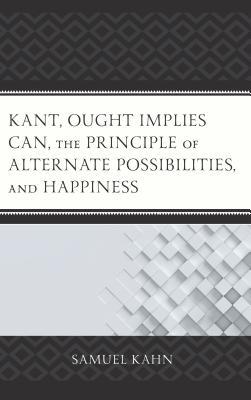
Kant, Ought Implies Can, the Principle of Alternate Possibilities, and Happiness
Moral Rights and the Limits of the Ought‐Implies‐Can Principle
Luminosity Failure, Normative Guidance and the Principle 'Ought
The Limits of Moral Obligation: Moral Demandingness and Ought
Bounded Ethicality and The Principle That “Ought” Implies
Ought implies can, asymmetrical freedom, and the practical
Ought implies can ethics and logic Britannica
The Best Argument for “Ought Implies Can” Is a Better Argument
Kant, Ought Implies Can, the Principle of Alternate - Amazon.com
'Ought' Imply 'Can'? And Did Kant Think It Does? - Oxford Scholarship
(PDF) Does 'Ought' Imply 'Can'? And Did Kant Think It Does?
Does 'Ought' Imply 'Can'? And Did Kant Think It Does? - White Rose
Samuel Kahn, Kant, Ought Implies Can, the Principle of
Does ‘Ought’ Imply ‘Can’? And Did Kant Think It Does?
Moral dilemmas, disjunctive obligations, and Kant's principle
The ought implies can (oic) thesis establishes a link between obligations and abilities. It is associated with kant, but the kantian attribution is debated. Its main interpretation goes along the latin motto ad impossibilia nemo tenetur and allows you to discharge an obligation when you lack the possibility to do what is commanded.
First, it is argued that while the principle of ‘ought implies can’ is certainly plausible in some form, it is tempting to misconstrue it, and that this has happened in the way it has been taken up in some of the current literature. In particular, it is argued that the principle has been used too strongly, to determine not only what we are obliged to do, but also what is right or wrong in itself.
Normative guidance and the principle 'ought-implies-can' - volume 30 issue 4� to give just a few examples: it is widely taken to be a central pillar of kant's.
Kant, ought implies can, the principle of alternate possibilities, and happiness [ kahn, samuel] on amazon.
This essay argues against the commonly held view that “ought” implies “can” in the within moral philosophy and some central principles within deontic logic. “moral dilemmas, gaps, and residues: a kantian perspective”, in maso.
If questions cannot be answered then they can't be asked, even immanuel kant stated a similar in his ought implies can principle.
In moral dilemmas, where circumstances prevent two or more equally justified prima facie ethical requirements from being fulfilled, it is often maintained that, since the agent cannot do both, conjoint obligation is overridden by kant's principle that ‘ought’ implies ‘can’, but that the agent nevertheless has a disjunctive obligation to perform one of the otherwise obligatory actions or the other. Against this commonly received view, it is demonstrated that although kant's ought-can.
This book examines three issues: the principle of ought implies can� the principle of alternate possibilities� and kant’s views on the duty to promote one’s own happiness. It argues that although kant was wrong to deny such a duty, the part of his denial that rests on a conception of duty incorporating both oic and pap is sound.
The natural candidates are the principle of alternate possibilities (pap) and the principle ought implies can (oic).
Kant, ought implies can, the principle of alternate possibilities, and happiness.
Ought implies can is an ethical formula ascribed to immanuel kant that claims an agent, if morally obliged to perform a certain action, must logically be able to perform it: for if the moral law commands that we ought to be better human beings now, it inescapably follows that we must be capable of being better human beings.
11 jun 2019 a standard principle in ethics is that moral obligation entails ability, or that “ought implies can”.
Attributed to the german enlightenment philosopher immanuel kant, the principle of ought implies can has been regarded as a minimal condition on the plausibility of any ethical theory: viz, no such theory is justifiable if it implies that agents have duties to perform actions that they are unable to perform.
Kant does not, so that there is an important divergence here which can easily be overlooked. The principle 'ought implies can' has been employed in several.
For kant, morality was not a matter of subjective whim set forth in the name of god or religion or law based on the principles ordained by the earthly spokespeople of those gods. Kant believed that “the moral law”—the categorical imperative and everything it implies—was something that could only be discovered through reason.
Kant, ought implies can, the principle of alternate possibilities, and happiness: kahn, samuel: amazon.
I have suggested that a typical use to which the principle that 'ought' implies 'can' is put is as a defeater of claims of moral requirement (when appropriate cannot-.
Post Your Comments: