Full Download Is the Higher Criticism Scholarly?: Clearly Attested Facts Showing That the Destructive ?assured Results of Modern Scholarship? Are Indefensible. - Rev Robert Dick Wilson Ph D file in ePub
Related searches:
Is the Higher Criticism Scholarly? by Robert Dick Wilson - Goodreads
Is the Higher Criticism Scholarly?: Clearly Attested Facts Showing That the Destructive ?assured Results of Modern Scholarship? Are Indefensible.
(PDF) UNSOLVED ISSUES IN THE HISTORY OF THE HIGH
A Scientific Investigation of the Old Testament: Wilson, Robert Dick
A Scientific Investigation of the Old Testament: 1926 Edition Reprint
THE HIGHER CRITICISM COMES TO AMERICA, 1880 - JSTOR
Is the Higher Criticism Scholarly?: Clearly attested facts
Is the Higher Criticism Scholarly?: Wilson, Robert Dick
Is the Higher Criticism Scholarly? - Kindle edition by Wilson
Is the Higher Criticism Scholarly? - tracts.ukgo.com
Is the higher criticism scholarly? Clearly attested facts
The History of the Higher Criticism SHARPER IRON
Robert Dick Wilson’s talk “Is the Higher Criticism Scholarly
Is the Higher Criticism Scholarly? by Robert Dick Wilson: New
THE HISTORY OF THE HIGHER CRITICISM – Christian Publishing
The History of the Higher Criticism by R. A. Torrey
THE HIGHER CRITICISM. AN INAUGURAL
Is the Higher Criticism Scholarly? Clearly Attested Facts
The Fallacies of the Higher Criticism by R. A. Torrey
The Higher Criticism of the Pentateuch
Fallacies of the Higher Criticism SHARPER IRON
Biblical Authority and the Impact of Higher Criticism in
The Fallacy of Higher Criticism (Isaiah -- Who Wrote It?)
The Higher Criticism of Islam Michael D Magee - Academia.edu
Has Higher Criticism Proved We Cannot Trust the Bible - JA
Higher criticism Article about higher criticism by The Free
The German Higher Critics: How Rational Were They
The Higher Criticism of Isaiah - UK Apologetics
The higher criticism Article about The higher criticism by
Higher Criticism and the Bible - Does God Exist? Today
The higher criticism - definition of The higher criticism by
Is the Higher Criticism Scholarly?, Book by Robert Dick
Analytical p-value calculation for the higher criticism test
Destructive Criticism and the Old Testament : Christian Courier
The Higher Critics - Victorian Web
The scholarly importance of studying - Inside Higher Ed
Higher Criticism The Canadian Encyclopedia
Does Higher Criticism Attempt to Destroy the Bible? - Dr
Researcher to Reader (R2R) Debate: Is - The Scholarly Kitchen
The higher criticism synonyms, the higher criticism pronunciation, the higher criticism translation, english dictionary definition of the higher criticism. Critical study of biblical texts to ascertain their literary origins and history and the meaning and intention of the authors.
The higher criticism has been of late so associated with extravagant theorizing, and with insidious attacks upon the genuineness and credibility of the books of the bible that the very term has become an offence to seri- ous minds. It has come to be considered one of the most dangerous forms of infidelity, and in its very nature.
Nor does modern translations attempt to perform the same, except for maybe a few exceptions. The problem isn’t really higher criticism, but rather it’s that some higher critics attempt to go too high and consequently provide a bad testimony of higher criticism. Parallelomania for instance, if it’s even a correct example.
Strauss encountered immediate fame and antagonism, losing his tubingen and later posts, though the higher criticism and the liberal approach top the lives of jesus received a major boost.
Is the higher criticism scholarly? clearly attested facts showing that the destructive assured results of modern scholarship are indefensible (1922) has 2 available editions to buy at half price books marketplace.
Answer: redaction criticism and higher criticism are just a few of many forms of biblical criticism. Their intent is to investigate the scriptures and make judgments concerning their authorship, historicity, and date of writing. Sadly, most of these methods end up attempting to destroy the text of the bible.
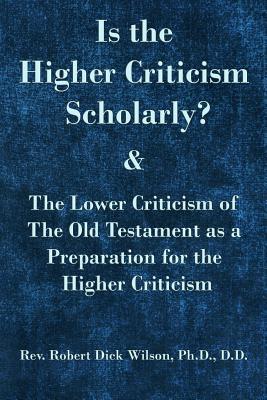
Is the higher criticism scholarly?� clearly attested facts showing that the destructive assured results of modern scholarship are indefensible robert dick wilson.
There is a higher criticism that is at once reverent in tone and scholarly in work. Hengstenberg, the german, and home, the englishman, may be taken as examples. Perhaps the greatest work in english on the higher criticism is home’s. Introduction to the critical study and knowledge of the holy scripture.
Higher criticism scholars have also raised questions about the authorship and dates of some of the psalms and hebrews. We must remember that higher criticism is the work of people who have preconceived ideas and prejudices that affect their conclusions. Higher criticism is at best a tool to help us understand some concepts related to god’s word.
This “documentary hypothesis” is most often associated with the german scholar, julius wellhausen. Indeed, higher criticism had been fostered in the extensive university system of the various german states, which encouraged original research and the emergence of a professional intellectual elite.
Here no one who senses even a spark of seriousness in themselves can claim to confirm or dispute the self-understanding of the sacred tradition as normative texts by means of higher criticism. 22 rather, criticism, especially tendency criticism, takes the claim of the tradition to normativity into account as a historical factor and makes this the object of historical analysis. Granted, that is perhaps modern and not intended by the ancient authors, but it is by no means out of keeping with.
Historical criticism (also known as historicism or higher criticism) refers to the study of literary texts, particularly ancient texts and especially the bible, in terms of their historical origins and development within those contexts. It is an umbrella term which describes the dominant method of study used by biblical scholars today.
Is the higher criticism scholarly? clearly attested facts showing that the destructive 'assured results of modern scholarship' are indefensible. By robert dick wilson, professor of semitic philology in princeton theological seminary (london: marshall brothers, 1922).
Just because a me scholar studies oppression related to race, gender or lgbt politics, for example, does not mean that they are prohibitively sensitive to constructive criticism. Nor does it mean that the questions they research necessarily reflect their personal views or interests.
To send this article to your kindle, first ensure no-reply@cambridge. Org is added to your approved personal document e-mail list under your personal document settings on the manage your content and devices page of your amazon account.
Criticism is inevitable, especially if we invite diverse perspectives and boldly lay out a big vision. Unfortunately, our response to the disapproval of others may not be entirely within our control.
Higher criticismhigher criticism is a term applied to a type of biblical studies that emerged in mostly german academic circles in the late eighteenth.
Google scholar provides a simple way to broadly search for scholarly literature. Search across a wide variety of disciplines and sources: articles, theses, books, abstracts and court opinions.
A number of scholars have criticized the lack of rigor in the historical.
Buy the hardcover book is the higher criticism scholarly? by robert dick wilson at indigo.
A patient and intelligent survey of 19th-century higher criticism written by a conservative. Is the higher criticism scholarly? clearly attested facts showing that the destructive 'assured results of modern scholarship' are indefensible.
Until at least the 1890s, irish presbyterian scholars rejected higher criticism because it threatened the plenary and verbal inspiration of scripture. Their understanding of biblical authority was shaped by the westminster confession of faith (1647) and by certain epistemological assumptions derived from.
Name given to a type of biblical criticism distinguished from textual or lower criticism. It seeks to interpret text of the bible free from confessional and dogmatic theology. Higher criticism sought to apply the bible to the same principles of science and historical method applied to secular works. It was largely dependent upon the study of internal evidence, although available data from linguistics and archaeology were also incorporated.
Scholarship to the study of the bible, the so-called higher criticism, a movement american scholars.
Higher criticism is a term applied to a type of biblical studies that emerged in mostly german academic circles in the late eighteenth century, blossomed in english-speaking academies during the nineteenth, and faded out in the early twentieth. Early modern biblical studies were customarily divided into two branches.
2 the hoax of higher criticism source ofethics and law in history. Itis the only writ ten document which is on the one hand unchanging and in need of no revisions, yet which is also fully applicable to man and his environment throughout history. Itis fixed, yet it applies to a world ofhistori cal change.
There is a higher criticism that is at once reverent in tone and scholarly in work. Hengstenberg, the german, and horne, the englishman, may be taken as examples. Perhaps the greatest work in english on the higher criticism is horne’s introduction to the critical study and knowledge of the holy scripture. It is a work that is simply massive in its scholarship, and invaluable in its vast reach of information for the study of the holy scriptures.
Higher criticism refers to a scholarly attempt to explain inconsistencies in the bible by identifying its original sources. As an interpretive tool, higher criticism is an important part of what scholars today refer to as the “historical-critical method.
Each of us has been asked to address some important questions about the� intersection. Of our own faith traditions and higher criticism— an apt metaphor, since “intersections” are where collisions often hap-pen. This brings me to my topic, protestantism and higher criticism, a messy.
In 18th century biblical criticism, the term higher criticism was commonly used in mainstream scholarship in contrast with lower criticism. In the 21st century, historical criticism is the more commonly used term for higher criticism, while textual criticism is more common than the loose expression lower criticism.
Despite a rich scholarly backing, many pundits, columnists, and even some scholars regularly deride the use of metaphor in public address. Oftentimes, this derision is based on a genuine desire to see public address move to what they see as a higher form of oratory.
Higher criticism originally referred to the work of a group of german biblical scholars centered in t bingen, including friedrich schleiermacher (1768–1834), david friedrich strauss (1808–1874), and ludwig feuerbach (1804–1872), who began in the late eighteenth and early nineteenth centuries to analyze the historical records of the middle east from christian and old testament times, in search of independent confirmation of events related in the bible.
With the truckloads of books dealing with early christianity from a historical-critical perspective, maybe scholars are going easy on islam. Why do you think this is or is not the case? i took for granted that much could be known about muhammad and the origins of islam, but further reading suggested this is very uncertain. However, unlike with christianity, there seems to be little scholarly.
Erasmus was a believer, as was jean austruc who used historical criticism to support mosaic authorship of the torah. Even today, believers from several christian traditions read the bible as historical critics in their scholarly work.
But in the 19th century, a discipline called higher criticism grew by such large proportions that scholars in europe were captured by it, and today the findings of the higher critics are taught as assured fact in most mainline seminaries across the united states.
Higher criticism higher criticism originally referred to the work of a group of german biblical scholars centered in tübingen, including friedrich schleiermacher (1768–1834), david friedrich strauss (1808–1874), and ludwig feuerbach (1804–1872), who began in the late eighteenth and early nineteenth centuries to analyze the historical records of the middle east from christian and old testament times, in search of independent confirmation of events related in the bible.
One criticism of open access is that apcs (article processing charges) burden authors financially. Less than one third of the journals in the directory of open access journals charge fees to authors — they’ve found alternative means of funding.
Popular sources most sources fall into two categories: scholarly and popular. Scholarly sources are written by highly-qualified researchers and have a thorough publication process, which usually involves peer-reviewing and an extensive list of references at the end of the text.
The higher criticism has sometimes been called the documentary hypothesis. But as all schools of criticism and all doctrines of inspiration are equally hospitable to the supposition that the biblical writers may have consulted documents, and may have quoted them, the higher criticism has no special right to this title.
Is the higher criticism scholarly? - kindle edition by wilson, robert dick. Download it once and read it on your kindle device, pc, phones or tablets. Use features like bookmarks, note taking and highlighting while reading is the higher criticism scholarly.
The discipline of higher criticism could be a valuable tool in bible study, but the higher critics for the most part start with the assumption that the bible is a record of human encounter with god through long centuries, and not with the belief that the bible is an infallible book written under the careful supervision of the holy spirit. Thus the bible (to the critics) bears the scars of human error.
As an interpretive tool, higher criticism is an important part of what scholars today refer to as the “historical-critical method. ” this expression refers to an approach to biblical interpretation that seeks to read the text “historically,” meaning in accordance with its original historic setting, and “critically,” meaning independent from any contemporary theological perspective or agenda.
Customers who bought this item also bought is the higher criticism scholarly. Clearly attested facts showing that the destructive “assured results of modern.
Is the higher criticism scholarly?clearly attested facts showing that thedestructive “assured results of modern scholarship” are indefensible. Professor of semitic philology in princeton theological seminary[originally published in 1922] age-long correspondence in the chronology of the bible and profane history.
The mere fact that a majority of modern liberal, rationalistic theologians accept higher criticism is hardly a guarantee that such a methodology is either impartial or legitimate.
Shaffer focuses specifically on the historicism implied by higher criticism to call for a reinvigorated practice of the literary discipline, to remedy the failings that she recognised in contemporary efforts, in which ‘the history of ideas appears if at all, deplorably impoverished, mechanical, and trivial’.
We get more sense from an ordained christian:the higher criticism of islam rev richard craigin spite of huge advances in biblical scholarship, ann widdecombe can still assert that st john's gospel is an eyewitness account of the life of christ.
If the higher criticism shall be adopted as the doctrine of the church, believers will be left in a distressing state of doubt and uncertainty concerning the narratives of the four gospels, and unbelievers will scoff and mock.
But in 1899 a new way of looking at scripture was beginning to appear on the scene, a view called german higher criticism, or german rationalistic criticism. Take note of the descriptive words, “higher” and, “rationalistic”.
There is a higher criticism that is at once reverent in tone and scholarly in work. Hengstenberg, the german, and horne, the englishman, may be taken as examples. Perhaps the greatest work in english on the higher criticism is horne's introduction to the critical study and knowledge of the holy scripture. It is a work that is simply massive in its scholarship, and invaluable in its vast reach of information for the study of the holy scriptures.
The expression “higher criticism” has to do with the study of sources, times, and the authorship of ancient literary documents. Many of the biblical “higher critics” have been grossly influenced by german rationalism. Accordingly, they have been “destructive” in their approach to the study of the bible.
Historical criticism is therefore closely related to this kind of analysis, and the effects on historical criticism of form criticism were very marked: it suggested that the gospels consist of collections of small units which have passed through a stage of oral tradition shaped according to the needs of the community.
But much of the evidence for the history of its structure is internal. The evaluation of such evidence is the province of what used to be called the higher criticism, a term first employed with a biblical reference by the german biblical scholar and orientalist johann gottfried eichhorn (1752–1827):.
Isthe highercriticism scholarly? clearlyattestedfactsshowingthatthe destructive•*assuredresultsof modernscholarship areindefensible robertdickwilson,ph.
Robert dick wilson’s talk “is the higher criticism scholarly?” (part 1 of transcript) the daily hatch robert dick wilson at the grove city bible conference in 1909.
Higher criticism began most notably with the french scholar jean astruc's work (mid-18th cent. It was continued by german scholars such as johann salomo semler (1725–91), johann gottfried eichhorn (1752–1827), ferdinand christian baur (1792–1860), and julius wellhausen (1844–1918).
By claiming that criticism of published ideas and pedagogical models is harassment, and by creating institutional mechanisms that erect barriers to wholly appropriate critique, entire lines of scholarship become exempt from scrutiny. The academic process depends on having the freedom not only to state ideas but also to criticize other ideas.
Scholarly sources are those that have been approved by a group with recognized expertise in the field under discussion. Books published by university presses fall into this category, as do articles published in peer-reviewed journals—journals where the editors send pieces out to be read by experts in the field before deciding to publish them.
Internet archive bookreader is the higher criticism scholarly? clearly attested facts showing that the destructive assured results of modern scholarship are indefensible.
Biblical criticism is the use of critical analysis to understand and explain the bible. During the eighteenth century, when it began as historical-biblical criticism, 1954) says that even though most scholars agree that biblical criti.
The term “biblical criticism” refers to the process of establishing the plain meaning of biblical texts and of assessing their historical accuracy. Biblical criticism is also known as higher criticism (as opposed to “lower” textual criticism ), historical criticism� and the historical-critical method.
Post Your Comments: