Download Market Liquidity Risk: Implications for Asset Pricing, Risk Management, and Financial Regulation - Andria van der Merwe file in ePub
Related searches:
Capital Market Liquidity and Implications for Insurance Companies
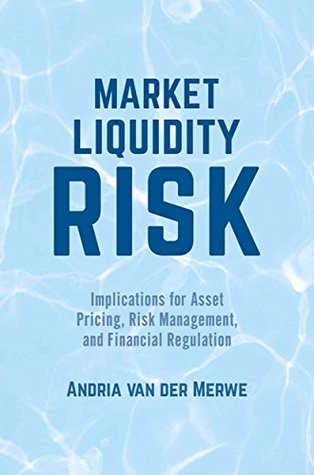
Market Liquidity Risk: Implications for Asset Pricing, Risk Management, and Financial Regulation
Liquidity Risk: Causes, Consequences and Implications for
Liquidity risk regulation and its practical implications for banks: the
Market Liquidity Risk - Implications for Asset Pricing, Risk
(PDF) LIQUIDITY RISK IMPLICATIONS FOR MARKET RISK
[PDF] Market Liquidity Risk: Implications for Asset Pricing, Risk
Market liquidity and stress: selected issues and policy implications
Investment Risks: Market, Credit and Liquidity Risk - Risk.net
Understanding liquidity risk and its role in the crisis VOX, CEPR
Liquidity risk implications for market risk assessment in - econstor
Market Liquidity and Funding Liquidity - The University of Utah
CHAPTER 3. MARKET AND FUNDING ILLIQUIDITY: WHEN
Liquidity Risk, Speculative Trade, and the Optimal - SEC.gov
(PDF) Modeling Liquidity Risk With Implications for
Market Liquidity: Research Findings and Selected Policy
Liquidity trends in the wake of Covid-19: implications for portfolio
Managing liquidity risk in a volatile market – and improving - EY
The Impact of Credit, Liquidity, Operational and Market Risks on
Market Liquidity and Funding Liquidity - SSRN
Liquidity Risk Definition and Meaning Capital.com
LIQUIDITY RISK IMPLICATIONS FOR MARKET RISK ASSESSMENT IN
Volume, liquidity, and liquidity risk
Liquidity Risk - Definition, Types and Examples of Liquidity Risk
Modeling Liquidity Risk, with Implications for Traditional
Stock Market Liquidity Implications For Market - beenews.com
Volatility, Liquidity, and Liquidity Risk - Columbia Business School
Five Dangers For Credit Markets Awash With Liquidity S&P Global
Modeling Liquidity Risk with Implications for Traditional
Risk Aversion, Market Liquidity, and Price Efficiency The
My Favorite Way of Measuring Market Liquidity And Why It's So
Market liquidity risk implications for asset pricing, risk management, and financial regulation by andria van der merwe and publisher palgrave macmillan. Save up to 80% by choosing the etextbook option for isbn: 9781137389237, 1137389230. The print version of this textbook is isbn: 9781349678631, 1349678635.
This paper estimates measures of market-wide liquidity along multiple dimensions and finds that each measure's innovations are correlated, that covariance of stock returns and innovations in each measure is priced, and combining the information in each measure improves the precision of estimated liquidity risk premia.
Implications for asset pricing, risk management, and financial regulation. Andria van der merwe provides a thorough guide to the critical tools needed to navigate liquidity markets and value security pricing in the presence of market frictions and information asymmetries. This is essential reading for anyone with a current or future interest in liquidity models, market structures, and trading mechanisms.
Market liquidity risk: implications for asset pricing, risk management, and financial regulation [van der merwe, andria] on amazon.
Oct 29, 2020 yet, the current situation bears several risks for credit markets, five of one of the unintended consequences of the liquidity wave currently.
The absolute growth in the size of bond markets magnifies the impact of any declines in liquidity provision by dealers.
The topic of bond market liquidity risk continues to attract significant back regulation, we need to adapt to regulatory change and its intended consequences.
Market liquidity risk: implications for asset pricing, risk management, and financial regulation [van der merwe, andria] on amazon. Market liquidity risk: implications for asset pricing, risk management, and financial regulation.
Due to the pandemic and the related market shocks that occurred during march 2020, treasurers and risk managers have been tested in ways not seen since the 2008 financial crisis. We anticipate banks may experience additional stress in the coming months as disruptions persist, national borders remain.
Andria van der merwe provides a thorough guide to the critical tools needed to navigate liquidity markets and value security pricing in the presence of market.
Chapter 4 – liquidity risk management: survey of current industry practices collateral, and the impact of market or liquidity stress on investments are the main�.
Market liquidity is an elusive concept, reflecting its multi-faceted nature. Having said this, a definition which seems to garner relatively wide support would be the following: a liquid market is a market.
Market liquidity risk: implications for asset pricing, risk management, and financial regulation details.
Hence the market risk is really in a pure form: risk in an idealized market with no friction in obtaining the fair price. However, many markets possess an additional liquidity component that arises from a trader not realizing the mid-price when liquidating her position, but rather the mid-price minus the bid-ask spread.
This book explores the effect of liquidity on asset prices, liquidity variations over time and how liquidity risk affects prices.
Market liquidity risk therefore has broad economic implications. Market liquidity risk affects how investment managers structure their portfolios; these portfolio.
Combine all this together – and you get a nice, easy-to-read way of measuring market liquidity. �� keep in mind that the nfci reads inversely – meaning any reading above zero signals tightening monetary conditions (drying liquidity). And anything below zero signals easing monetary conditions (flush with liquidity).
The size of the liquidity buffer is an important measure of liquidity risk, but more interesting is to run scenarios to assess the liquidity profile of the company under stress. This is similar to historical and imaginary market risk scenarios, except for the fact that the focus is on liquidity rather than solvency.
Nov 15, 2008 this funding liquidity crisis naturally lead to market illiquidity with bid-ask spreads widening in several markets, and quoted amounts being.
Market liquidity risk measurement market participants need to be aware of the implications of trading in markets that are not liquid at all times, that is, markets in which they cannot liquidate positions at going market.
Liquidity risk and market risk have no significant impact to return on asset. Research limitations/implications: bank conventional with period data 2014-2016.
The trade price of a liquid asset can be greater than the simple presentvalue of cash flows. As highlighted by many examples in this chapter, the 36market liquidity risknonmarketability of an illiquid asset reduces its value to much less thanthat of a liquid asset with the identical cash flow dynamics.
Market liquidity risk implications for asset pricing, risk management, and financial regulation.
Liquidity risk implications for market risk assessment in emerging markets.
Liquidity is a bank's ability to meet its cash and collateral obligations without sustaining unacceptable losses. Liquidity risk refers to how a bank’s inability to meet its obligations (whether real or perceived) threatens its financial position or existence. Institutions manage their liquidity risk through effective asset liability management (alm).
Turning to the implications for market liquidity, we first show that, as long as speculator capital is so abundant that there is no risk of hitting the funding constraint.
The impact on liquidity is not one to one with any particular change in policy. Market or transactions liquidity risk is the risk of moving an asset price against.
We also survey existing models to integrate market liquidity risk into risk frameworks. Usability and discuss relevant strengths, weaknesses and their implications.
Oct 28, 2020 the covid-19 crisis has triggered the deepest liquidity squeeze since 2008. Liquidity may dry up not only within risk assets, but also within risk free ones.
The liquidity risk definition refers to the lack of marketability of a security or asset, which timespan could expose a company to liquidity risk, resulting in negative consequences.
Market liquidity risk is the phenomenon that less liquidity is available in the market. This could be because there is no appetite to buy or sell assets. As a consequence, the insurer needs to find access to different funds to honour payments in order to prevent default on these payments.
To conclude, a blueprint if offered for dealing with expected market liquidity issues in asset pricing and risk management. Andria van der merwe provides a thorough guide to the critical tools needed to navigate liquidity markets and value security pricing in the presence of market frictions and information asymmetries.
Establish an analytic framework for calculating risk, optimizing capital and measuring market events and liquidity. Minimize the impact of market shocks, and look for better arbitrage opportunities, by analyzing the effects of changes in cost and liquidity in near-real time so you can act with precision.
When the market security is added, the liquidity of the original asset is an our paper is particularly related to three research strands: (1) the impact of tech.
With market and funding liquidity risks increasingly intertwined, and their potential systemic consequences, central banks will likely need to reconsider their role.
Cash and security live inventories address funding and market liquidity risks, the impact of what may be called “regulatory risk” on the capital requirements.
What is market liquidity? much like systemic risk, market liquidity is more easily recognised than defined.
There is no assurance that a portfolio will achieve its investment objective.
As has been widely noted in discussions of market liquidity, banks and brokers are now much more focused on attempting to match buyers and sellers of bonds and much less willing to assume risk.
There are many ways to categorize a company's financial risks. One approach for this is provided by separating financial risk into four broad categories: market risk, credit risk, liquidity risk.
Oct 15, 2016 since our findings are maintained at all levels of turnover, it is unlikely that merely thin trading fully drives our findings.
The liquidity-adjusted capm pricing model therefore states that, the higher an asset's market-liquidity risk, the higher its required return. [3] a common method for estimating the upper bound for a security illiquidity discount is by using a lookback option, where the premia is equal to the difference between the maximum value of a security.
The risk function develops models and calculates the implications of insurance and financial risk on capital and investments.
Its risk is the potential loss, because a security can only be traded at high or prohibitive costs.
Turning to the implications for market liquidity, we first show that, as long as speculator capital is so abundant that there is no risk of hitting the funding constraint,.
Find helpful customer reviews and review ratings for market liquidity risk: implications for asset pricing, risk management, and financial regulation at amazon.
Jan 16, 2020 funding or cash flow liquidity risk is the chief concern of a corporate treasurer who asks whether the firm can fund its liabilities.
Market liquidity risk therefore has broad economic implications. Market liquidity risk affects how investment managers structure their portfolios; these portfolio decisions affect equilibrium asset prices, and, therefore, the cost of capital of firms and governments.
It is generally near market peaks when investors are the most complacent about risk. While i certainly agree in the shorter term, the liquidity flood has mitigated downside risk; it only.
In section 1, implications for market liquidity and price efficiency are derived under risk neutrality of market makers. In section 2, the case of risk-averse market makers is discussed and some features of our model are compared to those of kyle’s 1989 model.
Nov 28, 2017 if your mutual fund holds securities that are less frequently traded and, therefore, less liquid, then you could be incurring higher trading costs.
Post Your Comments: