Download INDIA Mutiny to Mahatma and Swaraj ( A History of Hundred Years ) - Kamini Krishna file in PDF
Related searches:
INDIA: MUTINY TO MAHATMA AND SWARAJ: A HISTORY OF 100
INDIA Mutiny to Mahatma and Swaraj ( A History of Hundred Years )
Buy India Mutiny to Mahatma and Swaraj (A History of Hundred
The Forgotten Naval Mutiny Of 1946 And India's Independence
Mutiny of 1857 and Mahatma Gandhi – The Gandhi-King Community
Gandhi's Hind Swaraj :A Summary and Centennial VIew - Articles
India Mutiny to Mahatma and Swaraj (A History of Hundred
Mutiny of 1857 and Mahatma Gandhi - The Gandhi-King Community
Summary and Notes: Indian Home Rule by Mahatma Gandhi
GANDHI AND NEW INDIA - NITI Aayog
Sri Aurobindo and Swaraj - Times of India Blog
Concept of Swaraj and Mahatma Gandhi : A Critical Analysis
How Gandhi, Patel and Nehru colluded with Brits to suppress
Gandhi And The Tatas Tata group
Hind Swaraj or Indian Home Rule - Soil and Health
Swaraj, Agitation and an Intrepid Spirit: Dadabhai Naoroji’s
India’s first war for independence (aka indian rebellion of 1857) began as a mutiny of sepoys of theeast india company’s army on 10 may 1857, in the cantonment of the town of meerut, and soon escalated into other mutinies and civilian rebellions largely in the upper gangetic plain and central india, with the major hostilities confined to present-day uttar pradesh, bihar, northern madhya pradesh, and the delhi region.
After the mutiny of 1857, the incidence of hindu-muslim riots in india had come down sharply. By lending support to the khilafat movement of ali brothers in 1920, mahatma gandhi inaugurated a new era of a fresh wave of hindu-muslim riots.
12 nov 2019 salt march of mahatma gandhi in india - the salt march was one of the most to be one of the earliest examples of indian revolt against british rule in india.
Gandhi being a translation of 'hind swaraj' (indian home rule), published in the gujarat columns of indian opinion. 1909 preface to the english translation it is not the without hesitation that the translation of 'hind.
Introduction to the struggle for swaraj: the third and the last phase of the national movement began in 1919 when the era of popular mass movements was initiated. The indian people waged perhaps the greatest mass struggle in world history and india’s national revolution was victorious.
What is swaraj? reader� i have now learnt what the congress has done to make india one nation, how the partition has caused an awakening, and how discontent and unrest have spread through the land.
By swaraj, he meant freedom and self-rule which should be practiced at three levels – (i) in case of individual swaraj, it is self-control or swaraj of the self. (2) in case of the country, it is the freedom of india from the british clutch, and (3) in case of community level, it is grain swaraj or freedom of village.
Swaraj party was established to fight the mighty force of british rule in india. It was formed on 1st january 1923 by chittaranjan das and motilal nehru. This party was at first known as the ‘congress-khilafat swaraj party’ and later simply the ‘swarajya’ or ‘swaraj party’.
The 1857 uprising was the culmination of the recurrent big and small local of the chinese and arab travellers in the reconstruction of the history of india. Throw light on the significance of thoughts of mahatma gandhi in the pres.
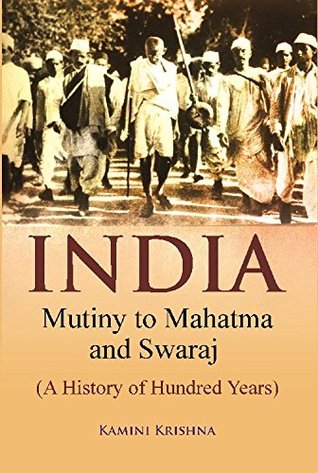
India mutiny to mahatma and swaraj (a history of hundred résumé this book gives a brief account of one hundred years of indian history mainly from mutiny to emergence of mahatma gandhi and finally swaraj.
Hind swaraj or indian home-rule comprises of 20 short chapters. It is written in a one, any resort to violent rebellion would require thousands of indians being armed which in itself is too much of a tall.
22 apr 2020 rudrangshu is regarded as a global expert on the revolt of 1857 in india and his first book, awadh in revolt, 1857-58: a study of popular.
In the swami's view, swaraj was the basis for freedom fighting. Dadabhai navroji said that he had learnt the word swaraj from the satyarth prakash of saraswati. According to mahatma gandhi, the overall impact of the state on the people is harmful.
This book gives a brief account of one hundred years of indian history mainly from mutiny to emergence of mahatma gandhi and finally swaraj.
By early 1900, the idea of ‘swaraj’ as the end purpose of india’s struggle against british dominion was taking foothold in colonial india.
In the introduction to “hind swaraj”, ‘a word of explanation’, mahatma gandhi writes in 1921, “if india adopted the doctrine of love as an active part of her religion and introduced it in her politics; swaraj would descent upon india from heaven.
Editions for hind swaraj or indian home rule: 8172290705 (paperback published in 1998), 8170288517 (paperback published in 2012), (kindle edition publish.
75 years ago on february 18 th 1946, the indian navy launched a historic mutiny that will live in our hearts forever and win a permanent place in the annals of history.
Gandhi viewed tata steel as a “great indian firm” and was so convinced that its success could herald “a miniature swaraj” that he travelled to jamshedpur in 1925 to resolve labour problems. Jamshedpur, in turn, supported gandhi in 1934, when he stopped there during his travels for the harijan movement.
The swaraj (self rule) that ghandi wants isn’t a system of the english with indian rulers. “you want the tiger's nature, but not the tiger; that is to say, you would make india english. And when it becomes english, it will be called not hindustan but englistan.
17 mar 2017 how creating a healthy “ecology of change,” as gandhi did in india, can help what type of organizing had allowed for this uprising to take place? as an essential component of the overall push for swaraj, or freedom.
The great rebellion of 1857 (also called the indian mutiny, sepoy rebellion, and gandhi in the 1920s and 1930s, the congress party made purna swaraj.
19 feb 2016 mahatma gandhi issued a statement criticizing the mutineers for revolting without any guidance from a political party.
Non-cooperation movement in his famous book hind swaraj (1909), mahatma gandhi declared that british rule was established in india with the cooperation of indians and had survived only because of this cooperation. If indians refused to cooperate, british rule in india would collapse within a year, and swaraj would be established.
Gandhi thought india’s independence would mean little unless it also meant the independence of every indian. This came across in february 1946, when a mutiny by indian ratings in ships of the royal indian navy created considerable excitement. Although no indian officer joined the mutiny, thousands of workers in mumbai struck work in sympathy.
It was one of gandhi's first organized acts of large-scale civil disobedience to induce the british government of india to grant self-government, or swaraj, to india.
India mutiny to mahatma and swaraj (a history of hundred years) by kamini krishna and publisher gyan publishing house. Save up to 80% by choosing the etextbook option for isbn: 9788121251693, 8121251699. The print version of this textbook is isbn: 9788121213226, 8121213223.
It was after the first world war (1914-1918) that mahatma gandhi came back to india and observed the condition of the country and started the non-violent agitation, satyagrah.
On 19/1/1922, he even sought to exclude indian citizens who were not members of congress from franchise in the swaraj that he promised: `swaraj means, in the event of the foregoing demands.
Sen has estimated that in the century since the indian mutiny of 1857 - 58, almost three hundred works have appeared on various aspects of the outbreak. As he points out, more has been written on the mutiny than on any other topic in indian history.
The purna swaraj declaration, or declaration of the independence of india, was promulgated by the indian national congress on 26 january 1930, resolving the congress and indian nationalists to fight for purna swaraj, or complete self-rule independent of the british empire (literally in sanskrit, purna, complete, swa, self, raj, rule, thus complete self-rule).
Mohandas karamchand gandhi was born in the year 2nd october 1869. Gandhi was considered “father of the nation” for his great deeds. He is the man behind india’s independence and inspired movements for freedom as well as civil rights.
Timeline of indian national movement ( 1857-1947) indian national movement is a series of events that took place with the main goal of bringing an end of british rule in india and achieve independence to india. The movement of indian freedom struggle mainly from 1857 to 1947.
The indian rebellion of 1857 began as a mutiny of sepoys of the east india company’s army on 10 may 1857 in the town of meerut and it spread soon in other part of india. It is also known the india’s first war of independence, the great rebellion, the indian mutiny, the revolt of 1857, the uprising of 1857, the sepoy rebellion and the sepoy mutiny.
Gandhi founded indian ambulance corps in 1899 to serve as a medical aid volunteer group.
14 aug 2015 for gandhi swaraj was getting independence from not only the foreign by gandhiji not only instilled a spark of non violent rebellion in south.
(a) it showed the greatness of mahatma gandhi (b) they were going beyond their own locality and emotionally identifying with an all-india movement (c) they were a unifying force of the non-cooperation movement (d) the various ways in which ‘swaraj’ was interpreted by different people.
Indian and the 1857 sepoy rebellion this collection contains dozens mahatma gandhi, hind swaraj, or indian home rule (1909) perhaps the most famous.
Prior to the sepoy mutiny in 1857, the fragmented nation of india was represented by the individual flags of the various princely states. Post the sepoy mutiny, the british established imperial rule in india and a flag was introduced to represent the british colony of india.
The indian mutiny of 1857 then led to the birth of the congress and freedom struggle. Mahatma gandhi’s struggle in the struggle for freedom in india, mahatma gandhi, the greatest man ever in indian history, had played a very important role.
Mahatma gandhi, who was strictly against violence, halted the non-co-operation movement on the national level on 12 february 1922, as a direct result of this incident. In spite of gandhi's decision, 19 arrested demonstrators were sentenced to death and 14 to imprisonment for life by the british authorities.
Mahatma gandhi - mahatma gandhi - place in history: the british attitude toward gandhi was one of mingled admiration, amusement, bewilderment, suspicion, and resentment. Except for a tiny minority of christian missionaries and radical socialists, the british tended to see him at best as a utopian visionary and at worst as a cunning hypocrite whose professions of friendship for the british race.
The life story of mahatma gandhi� he became a lawyer and returned to india at the age of 21 in 1891, a few months after his mother, putlibai gandhi, died in january. 2 years later, gandhi went to south africa in 1893 to work for a muslim indian law firm.
Whereas the mutiny has been the subject of many novels by british authors, and of only one indian novel, independence has been treated by many indian novelists, and noticeably fewer british writers.
This last episode covers the british east india company, the 1857 mutiny, the subsequent british raj, and finally india's partition and independence in 1947.
India comes under direct rule of the british crown after failed indian mutiny. The sepoy mutiny or the first war if independence took place. The east india company acquired the diwani of bengal, or the right to collect revenues onbehalf of the mughal.
Swaraj bhavan (formerly anand bhavan, meaning abode of bliss) is a large mansion located in prayagraj, india, best known for once being owned by the indian political leader motilal nehru and being home to the nehru family until 1930.
The indian independence movement was a series of historic events with the ultimate aim of main article: indian rebellion of 1857 bal gangadhar tilak was the first indian nationalist to embrace swaraj as the destiny of the nation.
Swaraj, agitation and an intrepid spirit: dadabhai naoroji’s final days. On the leader's death anniversary, a reminder that he had continued, until his 80th year, the movement against imperialism.
5 oct 2019 on 15th august, 1947 india attained freedom but the country stood partitioned. The people of india called it ' freedom struggle' while the britishers called.
The british parliament approved the india councils act on may 25, 1909, which crisis phase (february 1, 1919-february 4, 1924): mohandas gandhi, government troops suppressed the muslim rebellion in the madras province in moti.
As a matter of fact, it is not so, yet it is as well to impute our slavery to the whole of india. But if we bear in mind the above fact, we can see that if we become free, india is free.
11 oct 2018 the rise and growth of nationalism in india has been traditionally explained in in his famous book, hind swaraj (1909) mahatma gandhi declared that rebellion in the countryside: from the cities, the non-cooperation.
75 years ago on february 18th 1946, the indian navy launched a historic mutiny that will live in our hearts forever and win a permanent place in the annals of history.
In his famous book hind swaraj (1909) mahatma gandhi declared that british rule was established rebellion in the countryside: from the cities, the non-cooperation movement spread to the countrysi.
February 18th marks the 75th anniversary of the indian naval mutiny. Although this episode is ranked among the many that make up the saga of indian independence, it was one subverted by politics. Even as ordinary indians came out in thousands onto the streets in solidarity, congress leaders actively mediated only so that the naval continue reading the last mutiny.
10 arguably, the indian national movement at the moment when gandhi was writing hind swaraj was only a metaphor in gandhi's thinking, even as the political concerns of indians in south africa were immediate and pressing. A fourth approach studies gandhi as a disaffected liberal who rejected enlightenment categories of reason, state, progress.
Jallianwala bagh massacre, incident on april 13, 1919, in which british troops fired on a large crowd of unarmed indians in amritsar, punjab region, india, killing several hundred people and wounding many more.
Also known as the august movement, was launched by mahatma gandhi during world war ii at the bombay session of all-india congress committee on 8 august 1942 demanding an end to british rule in india.
By swaraj, he meant freedom and self-rule which should be practiced at three levels, š in case of individual swaraj,it is self-control or swaraj of the self. Š in case of the country, it is the freedom of india from the british clutch, and š in case of community level, it is gramswarajor.
Gandhi made the oppressed sections wake up and break their chains. He mobilised the people and united them to work for the cause of swaraj, which gave them a sense of belonging, a sense of purpose. For him, swaraj did not mean replacement of white masters by brown masters.
22 jun 2019 that were banned by the british—gandhi's hind swaraj and savarkar's first war of indian independence on the 1857 uprising.
When the first war of independence, commonly called as the sepoy mutiny, failed to defeat the british east india company rule in 1857, the administration was transferred to the british crown. A large section of indian muslims remained under the illusion that the british rule will go away in a few years, and muslims would return to power soon.
Hind swaraj shows that mahatma gandhi's sense of indian civilisational ethos draws from both the literary canon and oral folklore. Gandhi in this little booklet combines his cultural, political, and economic ideas succinctly. Mahatma gandhi's hind swaraj and its illuminating civilisational.
this book gives a brief account of one hundred years of indian history mainly from mutiny to emergence of mahatma gandhi and finally swaraj. It highlights the differences between hindus and muslims rulers which gave advantage to the europeans traders to capture indian market.
Purna swaraj and mahatma gandhi mahatma gandhi started a series of articles in the harijan and urged the british to ' quit india'. Furthermore, the congress put forth the resolution and demanded that british rule in india must end immediately.
His passion for india’s freedom was the influence of mahatma gandhi’s efforts to relieve india from britishers. He joined the freedom struggle, became the president of indian national congress and was eventually made the first prime minister of india post the independence.
The mutiny was suppressed by british troops and royal navy warships. The indian national congress and the muslim league condemned the mutiny, while the communist party of india was the only party that supported the rebellion.
Year event 1806 vellore mutiny 1809 east india company signs the first treaty of amritsar with ranjit mahatma gandhi returns to india.
The indian mutiny medal with central india clasp was awarded for service in central india january - june 1858, to all those who served under major-general sir hugh rose in actions against jhansi, kalpi, and gwalior. Also awarded to those who served with major-general roberts in the rajputana field force and major-general whitlock of the madras.
The indian people waged perhaps the greatest mass struggle in world history as a result of a major uprising during 1859—61 the peasants there had won their freedom from the indigo planters.
Antonio gramsci’s writings bring forth the distinction between the pre-modern, totalitarian state and the modern, hegemonic state. The british saw themselves as a “modern” and modernising state in india. Gandhi in 1908 mounted, in gramscian terms, a counter-hegemony, a war of position, in the form of the hind swaraj. It attacked colonising europe not on their not being european enough in a modern, hegemonic, sense, but in being fatally modern-european.
The royal indian navy revolt (also called the royal indian navy mutiny or bombay mutiny) encompasses a total strike and subsequent revolt by indian sailors of the royal indian navy on board ship and shore establishments at bombay harbour on 18 february 1946.
Post Your Comments: