Full Download Measuring Political Risk: Risks to Foreign Investment - Charlotte H. Brink | PDF
Related searches:
Commerzbank analyst simon quijano-evans recently analysed credit ratings for emerging market countries and concluded that there is a strong tendency to “under-rate” emerging economies – that is they are generally rated lower than developed market “equals” that have similar profiles of debt, investment or reform.
Risk is a situation in which the future outcome is unknown risks can be both expected and unexpected most commonly, risks occur due to changes in the cultural, economic, political, technological and geopolitical environment specifically political risk is of significant matter, because it is interrelated with almost all other types of risks.
Governments can monitor their own policy environment(s), and take remedial action if necessary. The methodology allows for measurement of previously un-quantified 'soft' factors that add to the risks foreign investors might face, demonstrating why these factors are of importance to both risk assertive and risk averse investors.
Geopolitical risk captures both the risk that these events materialize, and the new risks associated with an escalation of existing events. In the measurement step, we draw onsaiz and simonsohn(2013) andbaker, bloom, and davis (2016), and construct the gpr index with an algorithm that computes the share of articles related.
Once risks have been identified and measured, an effective system for active political risk management can be put in place. The first element in managing political risks is to map potential risk.
Political risks are creating both challenges and opportunities for global organizations, creating an imperative to develop more strategic approaches to managing political risk. The geostrategic business group helps companies to do this by translating geopolitical insights into business strategy.
The gpr index is a reminder that the question for political risk analysts is not the extraordinarily difficult task of measuring political risk writ large.
In this section, we introduce our firm-level measure of political risk. To separate measurement from interpretation, we begin by defining a measure of the share of the quarterly conversation between call participants and firm management that centers on risks associated with political matters.
A wide spectrum of political risks may affect business, and political risk analysts use both qualitative and quantitative methodologies to analyze and assess such risks. Although political risk analysis has a long history, a series of international crises in the 1970s prompted its development into an institutionalized business practice.
The second piece is performing the quantitative risk analysis, and what that is, it’s a process for numerically analyzing the effect of those risks on the project. The benefit of that is it helps support in decision-making to reduce the project uncertainty. Again, that can help us, number one, plan the risk responses and control those risks.
Political risk insurers charge premiums for political risk coverage against the confiscation of firms’ assets (expropriation risk), restricting the repatriation of profits or other capital transactions (transfer risk) or risks associated with war or civil disturbance (political violence risk).
Relationship between political risk and stock market performance and returns during major political events. In order to study this, first a after research into methods of measuring political risk, the united.
In a recent working paper titled aggregate and idiosyncratic political risk: measurement and effects, chicago booth professor tarek hassan and co-authors stephan hollander, laurence van lent, and ahmed tahoun employ an innovative methodology to try to narrow the gap in our ability to measure political risks and how firms react to them.
We first asked our survey respondents about how they quantify political risk (as business strategy guru peter drucker famously put it, “what gets measured, gets.
Measuring social and political risks for inclusion in return on investment (roi) calculations is a nine-step process.
These risks have lead to the development of an industry dedicated to providing insurance covering political risks for multinational operations.
Thus, the amount of deviation the business experienced should be recorded as the change in profitability due to aforesaid political risks.
Either as a measure of global geopolitical risks that are relevant for major tahoun, and van lent (2016) construct a measure of firm-specific political risk using.
Political risk insurance (pri), alongside a sophisticated understanding of the political risks facing a business, can help firms to manage their exposure and realize opportunities. The private pri market offers a set of credit and political risk coverages that policyholders can buy individually or together to create a bespoke insurance program.
Aug 8, 2019 we present a novel approach to measure the political risk faced by firms.
For example, the mean score for overall political risk increases significantly around federal elections. Furthermore, we show that our measure correlates with firm-level outcomes – such as volatility, investment, employment, political donations and lobbying activities – in a way that is highly indicative of reactions to political risk.
Oct 5, 2019 describe factors that influence the level of sovereign default risk; explain and assess how rating agencies measure sovereign default risks.
Do we really understand the drivers behind political risks? it is not easy to measure institutional quality with a single indicator, but it could be done using.
Apr 1, 2007 for entrepreneurs, countries fraught with such risks sometimes unfortunately, political risk is a subject many small and midsize businesses get wrong.
The authors failed to find any correla- tion between the risk measure and the dependent variable: losses because of political risk.
To investigate this relation empirically, researchers have traditionally used objective measures of political risk, including 1) electoral uncertainty 2) conflict risks, 3) social unrest, 4) corruption, 5) political instability, 6) quality of the institutions in the host country, 7) sovereign debt default risk, and 8) market imperfections.
The methodology allows for measurement of previously un-quantified 'soft' factors that add to the risks foreign investors might face, demonstrating why these factors are of importance to both risk assertive and risk averse investors. Features include: - 103 contextualized, measurable risk factors and their 411 risk factor indicators.
The geopolitical risk (gpr) index spikes around the gulf war, after 9/11, during the 2003 iraq invasion, during the 2014 russia-ukraine crisis, and after the paris terrorist attacks. High geopolitical risk leads to a decline in real activity, lower stock returns, and movements in capital flows away from emerging economies and towards advanced.
Political risk is the probability that political decisions, events or conditions will result in losses. Politics affect everything from taxes to interest rates and political events can dramatically impact the price of assets or cost of doing business.
How can asset allocators quantify the effects of political risk on financial markets? a simple and tractable one approach to measuring the effect of political risk.
In order to design a comprehensive model for political risk analysis, one has to think of how to go about measuring something as elusive as political risk. The book started out by establishing the context of political risk and explained what it entails, what other authors think it means, and even more importantly, what it does not mean.
In a recent working paper titled aggregate and idiosyncratic political risk: measurement and effects, chicago booth professor tarek hassan and co-authors s tephan hollander, laurence van lent, and ahmed tahoun employ an innovative methodology to try to narrow the gap in our ability to measure political risks and how firms react to them.
Political risk is influenced by the passage of laws, the foibles of leaders, and the rise of popular movements—in short, all the factors that might politically stabilize or destabilize a country.
Iso 31000 provides a new definition of risk that is especially useful for measuring legal risk. Risk management then starts with identifying uncertainty and then evaluating effects (positive and negative).
Understanding of the relationships between political risks, institutional private sector perspective, efforts to assess and measure political risk focus on factors.
However, quantifying the effects of political risk has often proven difficult due to a lack of firm-level data on the extent of exposure to political risk, as well as a lack of data on the kind of political issues firms may be most concerned about. We present a novel approach to measure the political risk faced by firms.
A lack of data measuring (or even defining) political risks adds to the confusion, with investors relying on “breaking news” headlines, ad hoc punditry and their own implicit (or sometimes.
Efforts within the private sector to measure and anticipate political risks relevant to business decisions.
With both global and bond specific factors in place, column (iii) presents estimates adding country-level measures of economic and political risks obtained from.
Country risk refers to a country's economic and political risks that may affect its businesses and result in investment losses. These evolving risk factors are critical for international investors to monitor over time. Here's how to quickly and easily measure and analyze country risk.
Political risk also appears to have a large and measurable impact on investment. In a typical country, a 1% drop in the political risk spread leads to a 12% rise in net fdi inflows. This political risk measure can also predict adverse events that could impact investment.
Risk ratings carry any additional information beyond these macroeconomic statistics (cosset and roy, 1991). And yet another striking example of the inadequacy of conventional political risk measures involves the recent east asian financial crisis. To the surprise of many members of the corporate, policymaking and academic communities,.
This type of risk is mainly associated with the losses resulting due to the political situations of a country. Even a politician’s comment might not settle down well in the international community, thus contributing to country risk. Measuring and analyzing country risk isn’t a straightforward task.
Developed countries engender fewer risks than developing countries, due to the better-developed legal institutions, norms, and practices for business.
The gpr index, like many other political risk ratings or metrics, is a useful indicator for a political risk analyst. But it is nonetheless measuring only a proxy for political risk. The global phenomenon of political risk is made up of numerous discrete risks — wars, expropriations, trade barriers — that are unevenly distributed across.
While this is a standard risk measure for integrated capital markets, many have found the world beta model inadequate to characterize risk in emerging markets.
Thought about risk until the middle ages, it is ironic then that it was an italian monk, who initiated the discussion of risk measures by posing a puzzle in 1494 that befuddled people for almost two centuries. The solution to his puzzle and subsequent developments laid the foundations for modern risk measures.
We validate our measure by showing it correctly identifies calls containing extensive conversations on risks that are political in nature, that it varies intuitively over time and across sectors, and that it correlates with the firm’s actions and stock market volatility in a manner that is highly indicative of political risk.
Quantifying political risk: how to measure the seemingly unmeasurable.
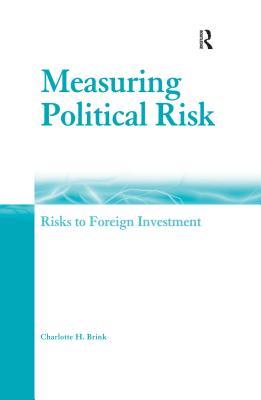
Offering a fresh, transparent approach encompassing new material, this invigorating volume measures political risk - for instance the risk that foreign investment might face in any country. It also demonstrates how progress or regress made in good governance initiatives as conditionalities to aid can be assessed.
There are examples of the intricate relationship between political risks and financial develops a model to measure political risk for foreign direct investments.
Measuring political risk; hearings before the committee on immigration and naturalization house of representatives seventy third congress first session relating to naturalization and citizenship status of children whose mothers are citizens of the united states and relating to the removal of certain inequalities in matters of nationality mar 28 1933.
Political risks are risks associated with changes that occur within a country's policies, business laws, or investment regulations. Other influential factors include international relationships and any other situation which may have an influence on the economy of a given country.
Aug 1, 2017 this week i talked with groupe seb turkey's cfo mustafa kilic about geopolitical risks in emerging markets and working capital/liquidity.
Post Your Comments: